Our mind is limited, and as such, it needs to select the information that matters and discard whatever adds no value. It is a basic mechanism for optimizing resources, and without it we would probably be unable to handle everything we receive. In fact, overstimulation is one of today’s problems, because the amount of information that comes to us through audiovisual media ends up exhausting and even harming our mind. Everything in moderation, and that includes stimuli as well.
This mental tool for eliminating irrelevant information is present at every moment of our lives, and of course it is also active when we travel. It is impossible to retain all the visual information we gather from the landscape and from the scenes that unfold as the kilometres go by without overloading our mind. But the amount of detail we keep also depends heavily on our attitude. It is not the same to drive on autopilot, thinking about our own things, while the act of driving happens almost automatically, as it is to stroll calmly while enjoying the scenery or to head out in photographer mode, paying attention to every small detail that might be worth capturing with the camera. These are three very different attitudes that awaken very different levels of attention and concentration.
The photographer’s driving is active, conscious and alert. Every detail is observed, every corner is scanned in search of a remarkable, different and meaningful image that can be preserved in a timeless frame. This level of presence pulls us away from seeing without truly seeing, from ignored stimuli, and immerses us in a whirlwind of sensations, details and ideas that spark our imagination and settle in our conscious memory. It is a deliberate act of sensory hyperstimulation that puts us to the test and challenges us to push our ability to process information to the limit. I admit that it can sometimes be tiring, but it is also deeply stimulating.
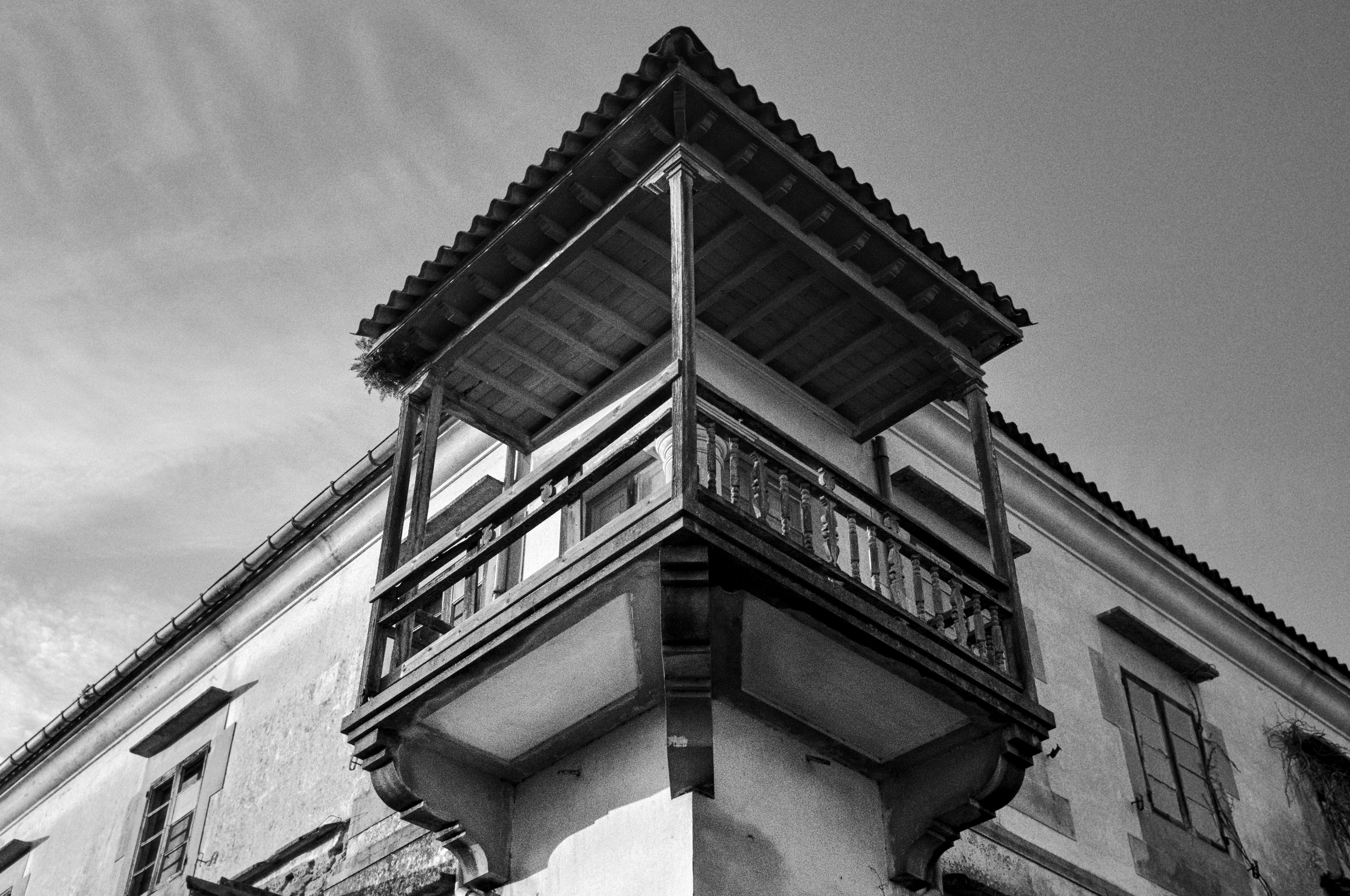
The image I am sharing today is precisely the result of this conscious effort to look for the smallest and most elusive stimulus, the kind that would have escaped us completely if we had not been fully focused. I have passed through this village countless times on my way to Coruña and had never noticed this peculiar building. The fact that it is not next to the road but set back behind several houses makes it very difficult to spot. When I drove through Leiro, which is the name of the village, looking for something to photograph, I barely noticed a small detail of its balcony in my peripheral vision, something that could have gone completely unnoticed if I had not been paying full attention. I did not stop that day, because it was already getting late, but I kept it in mind to explore on one of my next visits.
And the truth is that the next time I went through the village it took me a while to find the building, because it is really hidden from the road. It is incredible how far our ability to perceive even the smallest detail can go when we are truly focused, something that photography is able to develop to unexpected levels. One more virtue of this fascinating activity that I never grow tired of practising.
