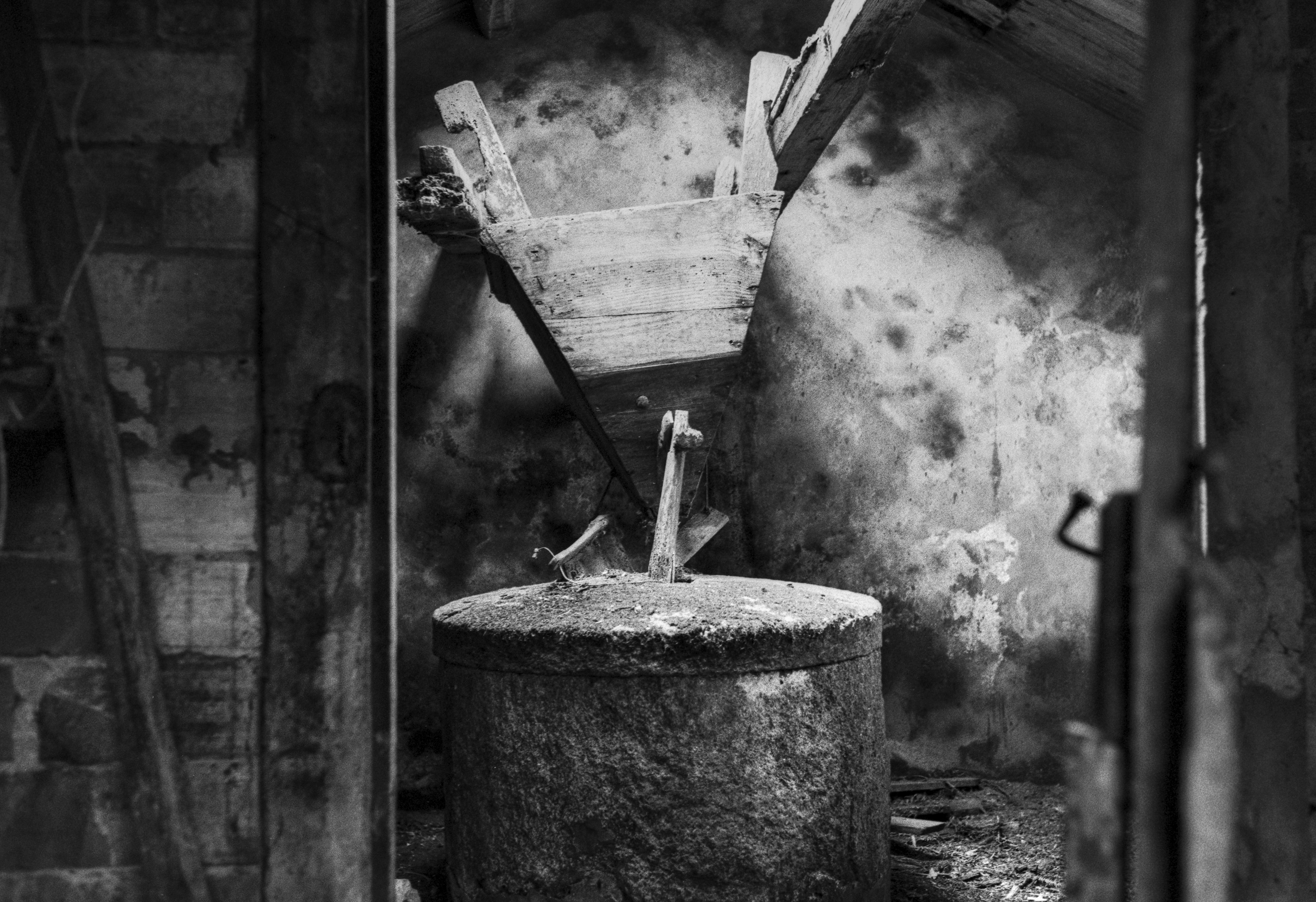
The first time I ever saw the inside of a mill was thanks to my godfather. Near the beach we often visited, there was one that belonged to him. It was a small stone building, hidden beneath some trees and overrun with undergrowth. It fascinated me, it looked like it held some legendary secret and felt like an impenetrable fortress.
One day, as we were walking back from the beach, I asked my godfather if we could visit it. To my surprise, he offered to show it to us, and the following weekend he grabbed his huge key and took us there. After fighting our way through the brambles at the entrance and giving the door a little push, it creaked open, revealing total darkness inside. For a few seconds, we couldn’t see a thing, then, gradually, a small space began to take shape. There were some tools, and the room was very small. Inside, there was another door that led to the mill’s machinery. When we opened it, we found a scene very much like the one I’m sharing today.
I was absolutely fascinated by the mechanism. A large wooden moega (hopper) rested elegantly above the moa (grindstone), and in the caneta (grain chute) you could still spot a few forgotten grains from the last milling. After turning the volante do erguedoiro (lifting handle) slightly, my godfather made the moa spin, just as it would have when the water struck the rodicio (waterwheel). For me, it was one of those magical childhood moments that stay with you for life. From that day on, I often asked my godfather to take me back to the mill on weekends.
The one in this photo is in the village of Bares. It’s in very poor condition, and unless immediate action is taken to prevent further deterioration, I doubt it will survive many more years with all its parts intact. It’s a real shame, because neglecting our heritage is a form of societal madness.
