Our minds like to simplify, categorize, label, compartmentalize knowledge, and draw neat conclusions. It’s a useful trait: it allows our limited cognitive resources to tackle highly complex problems successfully. But it comes at a cost, we reduce the complexity of the world around us to its simplest form.
That’s why, when we think of certain concepts, our minds default to their most basic representations. If someone mentions painting, we think of a framed canvas. If they mention music, we imagine a song. Literature? Perhaps the last book we read. Architecture? Likely a sleek, modern building with clean lines.
The same thing happens with photography. We tend to reduce it to a single image. Our minds equate photography with its outcome, or, at most, with the tool used to create it. But if there’s one thing I’ve been learning lately, it’s that the final result is often the least important part. The photographic process goes far beyond that, it transcends the image itself.
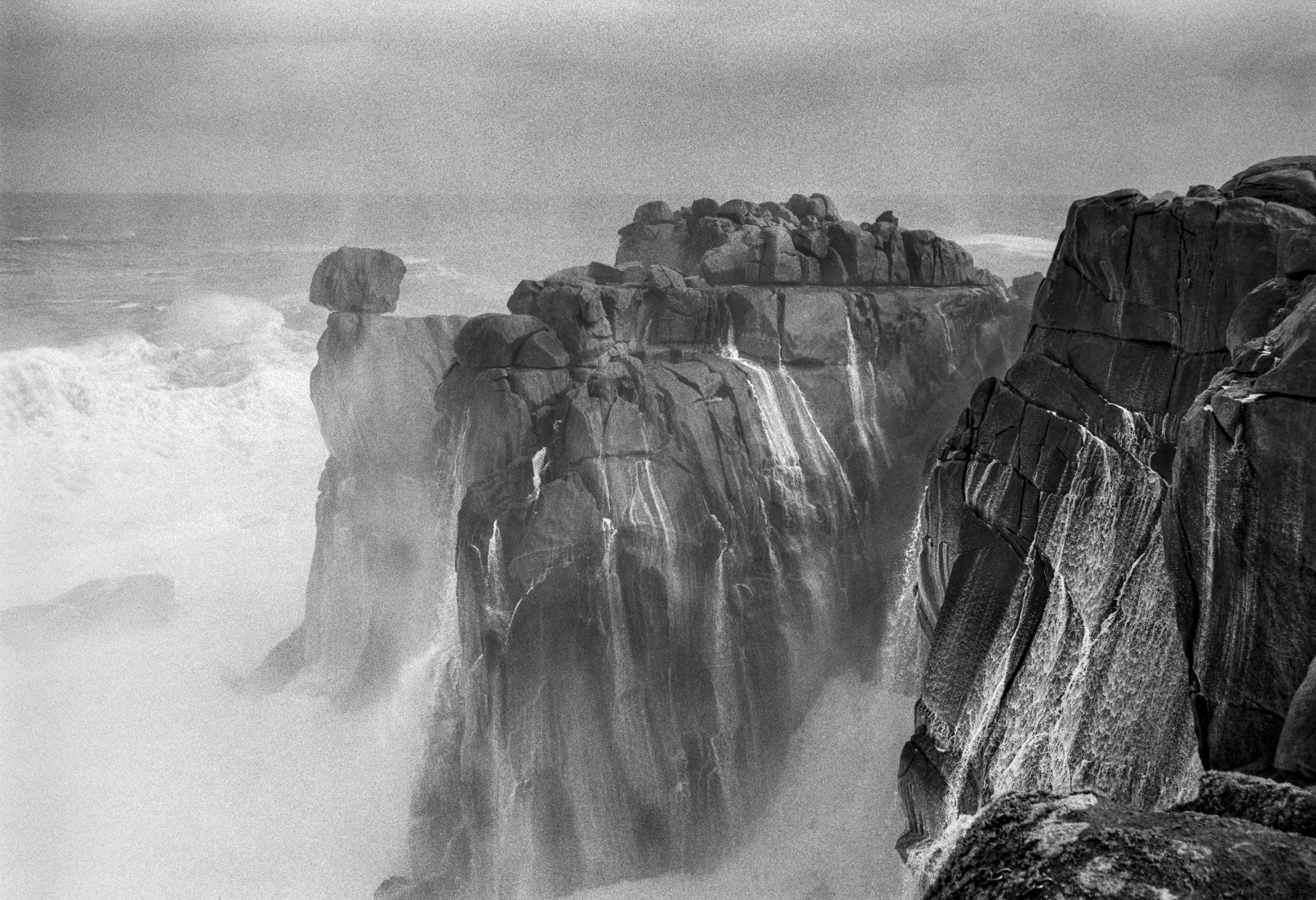
The photo I’m sharing today is a good example. I do like the result; it’s a satisfying image. But the image itself is nothing compared to the experience of being there, in that place, at that moment, under those conditions, feeling the storm, watching the sea rise vertically like a wall of water, reaching the height of a multi-story building. If it weren’t for photography, I would never have lived that moment. I wouldn’t have gone out in that kind of weather. I wouldn’t have had the chance to witness and preserve that instant.
The photo is just a simplification of the entire process, but it doesn’t transcend it, and certainly doesn’t surpass it.
