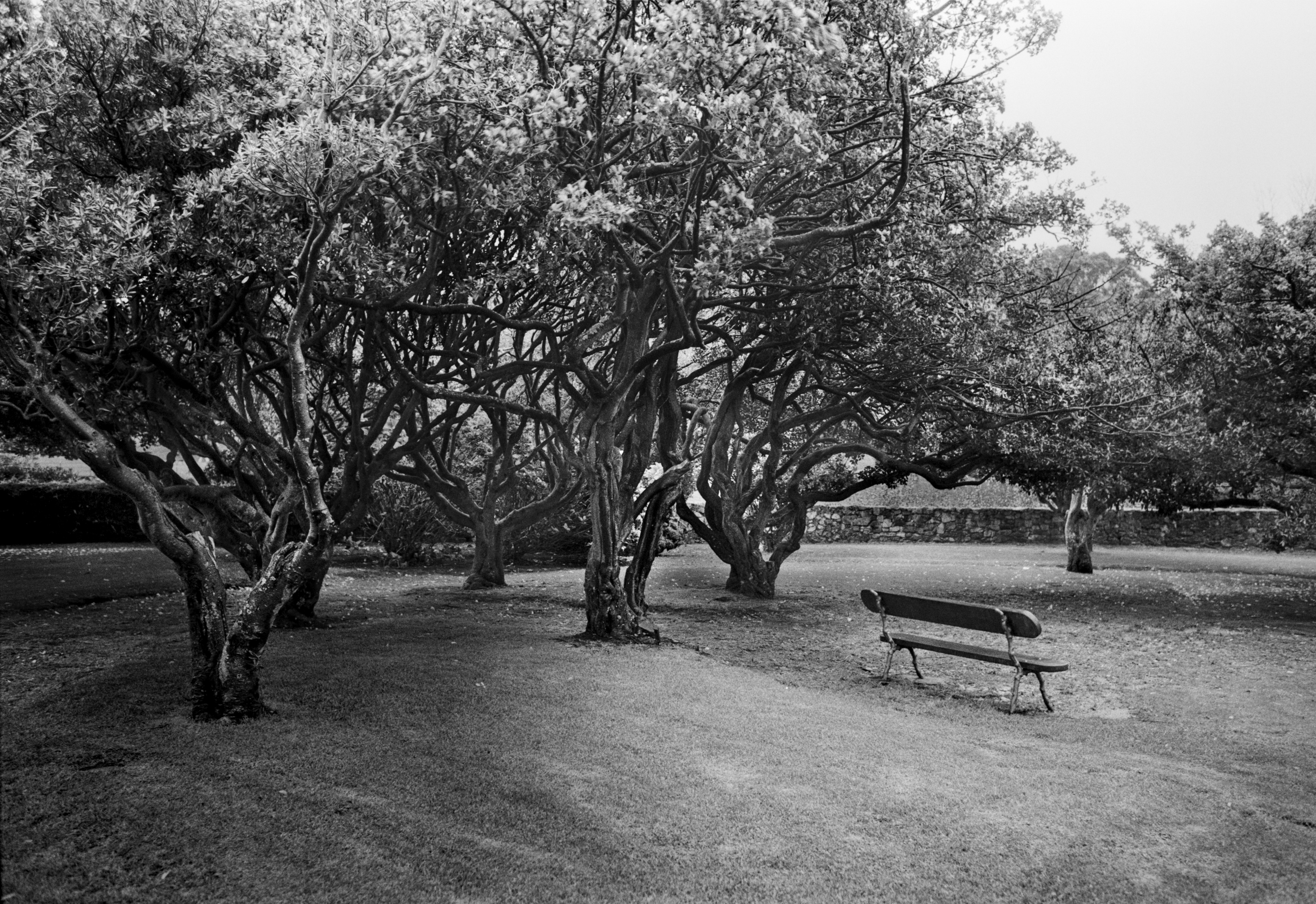
One quality that almost all of my photographs share, aside from the absence of color, is the absence of people. My family always has two categorical critiques: “Take your photos in color!” and “Photograph people!” Of course, I don’t listen, but sometimes their comments do make me think.
I actually love color photography, especially analog color photography, with its soft, warm tones and that grainy texture that gives it such an organic feel. But I also have a deep passion for black and white. Stripping away the color might seem like a limitation, you’re removing a large portion of the visual information, but in reality, it’s liberating. That absence becomes an opportunity to bring forward elements that were otherwise hidden. Color tends to steer you toward specific lighting conditions or harmonious palettes, while black and white asks you to focus solely on shapes, lines, and contrast. They’re different languages for expressing different sensations.
Something similar happens with people in photography, they demand and eclipse our attention. We’re hardwired to focus on them; they capture our gaze instantly. It makes sense when you consider that much of our brain’s evolutionary development was dedicated to managing social interaction, despite the huge energy cost it entailed. Because of this, the presence of people in a photograph often overpowers the supporting elements of the scene. That, combined with my own introverted personality, heavily influences the kind of scenes I tend to capture.
So, those are the two pillars that shape my photography, or, put another way, that give it its personality. The photo I’m sharing today, taken at Monte de San Pedro in A Coruña, reflects both traits. It strips away all color, which actually works in its favor, since the day was very overcast and the light wasn’t particularly compelling. However, the shapes of the trees are enhanced by the interplay of light and shadow, something that black and white brings out beautifully. And because the bench is empty, there’s no human presence to distract the viewer. We’re left to fully engage with the scene itself.
This approach to photography may not always be understood, but in the end, photography isn’t about being understood. It’s about being felt.
